

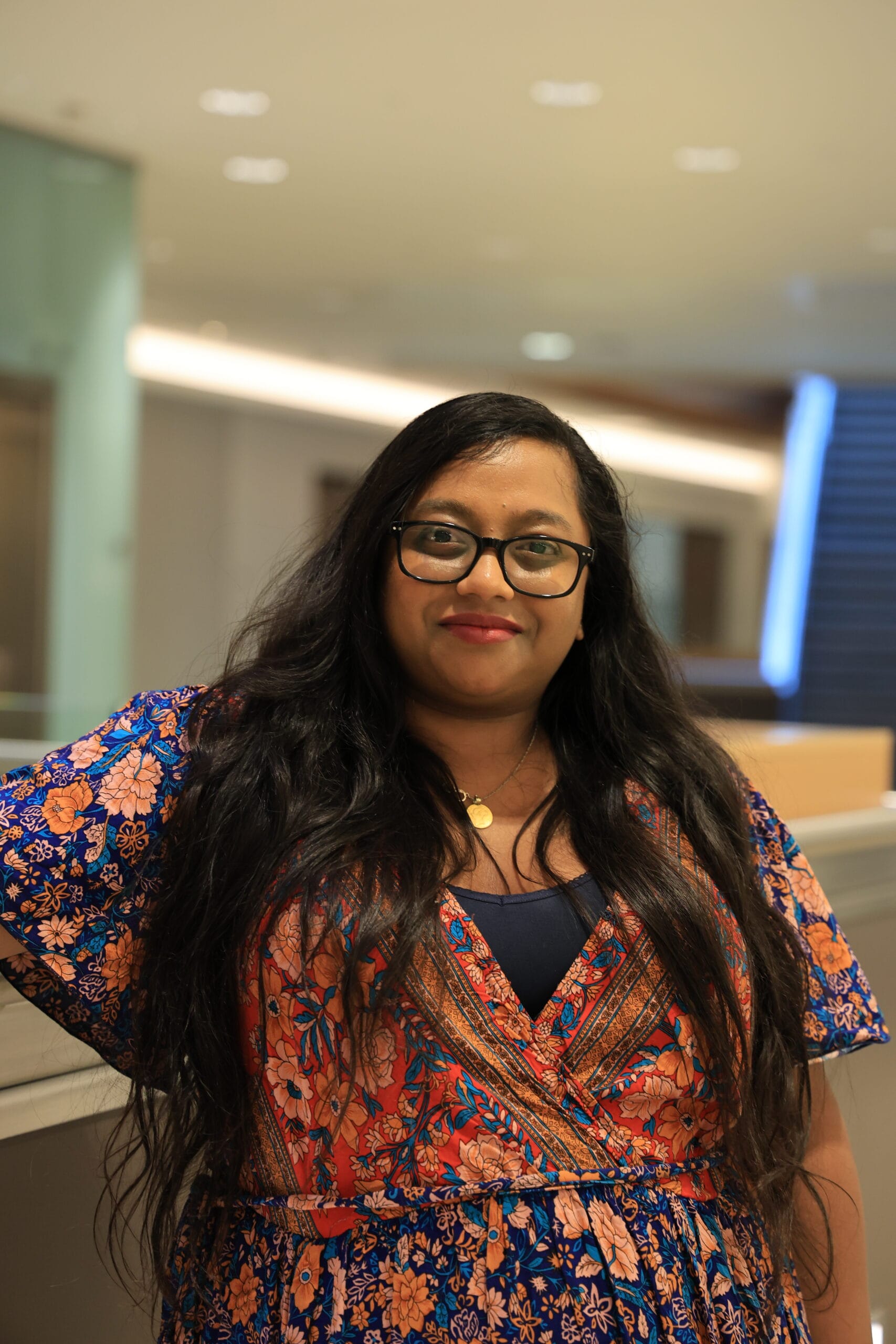

UKZN Alumnus Pioneers Parkinson’s Research at University of Oxford
Dr Kalina Naidoo, a postdoctoral researcher at the Wade-Martins Lab within Oxford’s Department of Physiology, Anatomy and Genetics (DPAG), is making significant strides in the field of Parkinson’s disease research, driven by her passion for understanding the complexities of the human brain and the neurodegenerative disorder that affects millions worldwide.
Her connection to her alma mater UKZN was more than academic; it was personal. ‘I arrived as an undergraduate in Medical Science and felt a sense of community in the College of Health Sciences, to the point that the corridors of E block quickly felt like a second home, and its residents a second family,’ she said. This sense of belonging fuelled her academic pursuits, leading her to complete a Master’s degree in Medical Science at UKZN.
It was during her time as a Master’s student that Naidoo stumbled upon an opportunity that would change her life forever. ‘I was waiting for an elevator at the Medical School campus when an advert for a scholarship opportunity caught my eye,’ she said. The simple advert, in the form of a checklist of eligibility, encouraged her to apply for a scholarship to study in the UK.
Little did she know, this would be her gateway to Oxford. ‘If I hadn’t seen an advert for scholarship applications to the University of Oxford, I’d never have applied – I never thought I was Oxford material,’ she said. But the checklist format made the advert more objective in its description, and, therefore, less daunting. It gave her the confidence to pursue her dream, leading her to become a recipient of the prestigious Cecil Renaud Overseas Scholarship in 2015.
The scholarship not only provided her with the financial means to study at Oxford but also equipped her with essential skills that would later prove invaluable in her career. From crafting a compelling personal statement to networking at conferences and becoming an active member of her academic community, the scholarship experience was instrumental in her development as a researcher.
Naidoo’s path to becoming a neuroscientist was not a linear one. ‘I’d love to say that I was one of those kids who knew what they wanted to be ever since they were five years old – but I was not,’ she said with a smile. ‘I toyed with the idea of medical school, I loved biology, most of my friends were applying for it, and I knew it would make my grandfather happy. When I didn’t get in, that was the biggest failure in my young life.
‘In retrospect, that failure was a stepping stone to my success, because in picking my second option, I got to meet one of my first and greatest loves – neurobiology!
Anybody who is going through a setback right now, I urge you to remember that this might just be your slingshot moment, because sometimes you need to be pulled back in order to fly further.’
‘Growing up, I had the kind of parents who powered my own hopes and ambitions with their unrelenting belief in my capabilities,’ she said. This support led her to pursue a degree in Physiology at UKZN, where she attended her first lecture in neuroscience by Professor Willie Daniels. That lecture ignited a lifelong passion. ‘In that same moment, I knew what I wanted to spend the rest of my life learning about
– how to add quality to life, and not just quantity,’ she said. This revelation set her on a path to dementia research, where she now focuses on Parkinson’s disease.
Naidoo’s research career has not been without its challenges. The COVID-19 pandemic struck just as she was about to buckle down and write her PhD dissertation. ‘I didn’t quite expect the world to follow suit as well!’ she said. However, the pandemic did pose significant hurdles, leaving her with less experimental work than she had hoped for and no first-author publication, a critical milestone for an aspiring academic.
Undeterred, Naidoo took on a postdoctoral research assistant position at the Wade-Martins Lab, using the opportunity to prove her worth. ‘I used my foot in the door to prove myself to Richard [Wade-Martins],’ she said. Her initiative and dedication paid off, and she was promoted to a full postdoctoral researcher within six months of being hired. This experience taught her the importance of perseverance and making the most of every opportunity, even if it meant taking a job she felt overqualified for.
Her current research addresses two of the most pressing challenges in Parkinson’s disease: developing more accurate early diagnosis protocols, and the development of therapies that can modify the course of the disease. Her project seeks to explore Parkinson’s as a disease with distinct clinical subtypes, investigating whether these subtypes have a biological basis. This approach holds the potential to revolutionise how the disease is treated, paving the way for therapies tailored to individual patients based on their specific symptoms.
Although her current project is still in its early stages, Naidoo has already made significant strides in the field. In a previous project, she optimised a novel imaging technique to measure an enzyme linked to a particular genetic mutation (GBA N370S) associated with Parkinson’s. This innovation could become a valuable tool for researchers exploring this mutation and its role in the disease.
Looking ahead, Naidoo is passionate about expanding her research to include a South African cohort. By focusing on the genetic factors that influence Parkinson’s in this population, she aims to contribute to a more comprehensive understanding of the disease and ensure that treatments and therapies are informed by a diverse range of patient data.
She is also excited about emerging trends in Parkinson’s research, particularly those exploring the gut-brain axis. Her previous work on how gut microbial products affect stress signalling in the body has sparked an interest in how these mechanisms might influence Parkinson’s disease. She envisions a future where treatment strategies could include not just pharmacotherapy, but also interventions targeting the gut microbiome, offering a more holistic approach to managing dementia and related conditions.
Naidoo’s accomplishments also extend beyond the lab. She is incredibly proud of her students, whom she mentors in various capacities, including as a tutor of final honours students at Oxford and a lecturer in the Oxford Prospects Programme. Her dedication to teaching and mentorship highlights her commitment to shaping the next generation of scientists.
‘A few years back, I had a student in my summer school class with extreme social anxiety,’ said Naidoo. ‘She was being homeschooled, but desperately wanted to study abroad. Her parents had sent her to numerous summer schools but she would always drop out, but that year, she didn’t; she made it right to the end of the course, and I have never been prouder of anything else I’ve done in my career,’ she said.
Family and culture have also played a significant role in Naidoo’s life, providing her with a strong foundation from which to pursue her dreams. Growing up in
Chatsworth, she was surrounded by a loving and supportive family, including grandparents who indulged her childhood fantasies and a little brother who became her lifelong best friend. ‘Living in Oxford, surrounded by all its grandeur, I’ll never feel the richness I felt when I lived on the main road in Chatsworth, because our life was appraised in something far greater than the British pound – love and a sense of community,’ she said. This deep sense of belonging and connection to her roots continues to influence her life and work.
‘I miss the ‘make a plan’ attitude of South Africans the MOST!’ she said. This resourcefulness and positivity are qualities she brings to her life in the UK, much to
the bemusement of her British friends. Yet, it is this very spirit that has carried her through her journey from UKZN to Oxford.
Her advice to current UKZN students is simple yet profound: ‘This is a Dr Who quote that I love, ‘Always try to be nice, but never fail to be kind.’ She emphasised the importance of framing your story around your own goals and maintaining a sense of community and resilience. She encouraged students to be as specific as possible with their questions as this will increase their chances of receiving helpful feedback.
‘I also urge you to make time for your hobbies – if it were not for my love for reading and writing Harry Potter fan fiction, I don’t think I would have been able to pen a strong personal statement. While doing my PhD, I was head of communications for a student science charity that honed my science communication skills, which definitely helped in interviews. Being social chair of my college common room helped me develop interpersonal skills that are the foundation of any team-centred careers.
Seek out personal development in a variety of forms, if you can!’


