
UKZN Launches Aerospace Institute: Pioneering South Africa's Journey into Space
For 15 years, engineers at the University of KwaZulu-Natal (UKZN) have been delving into the world of aerospace engineering, driven by a vision to launch South
Africa into the realm of space exploration. Now, with the official launch of the Aerospace Systems Research Institute (ASRI), that vision is closer to becoming a reality.
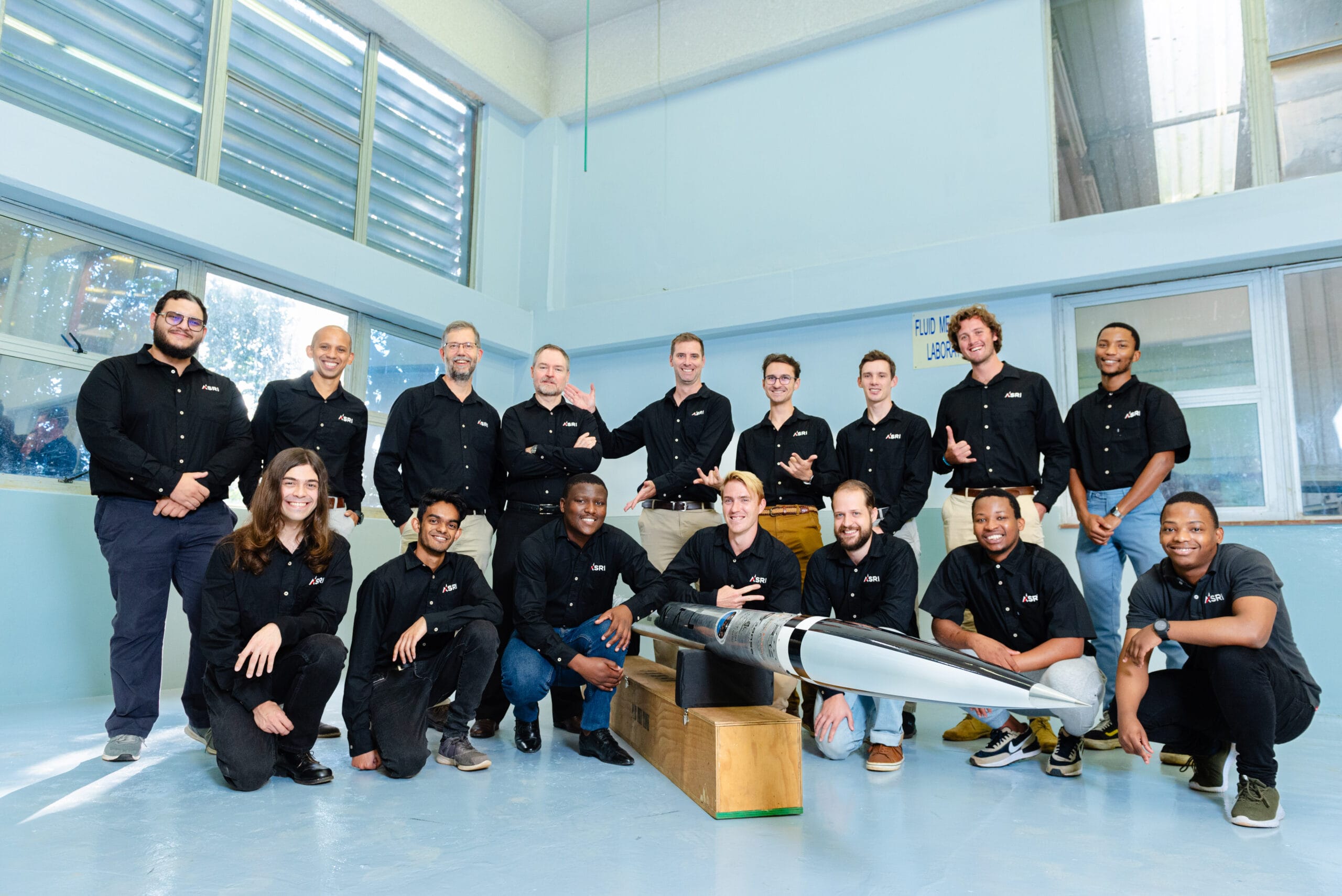
ASRI, born out of the pioneering efforts of UKZN and the Department of Science and Innovation, aims to develop a home-grown commercial launch vehicle capable of placing satellites into orbit from South African soil. Spearheaded by Professors Michael Brooks, Jean Pitot and Glen Snedden, ASRI is paving the way for South Africa’s entry into the space race. Brooks is the institute’s Director and is a member of both the South African Institution of Mechanical Engineering and the Aeronautical Society of South Africa. He is also a registered professional engineer.
The journey towards establishing a viable space launch capability is fraught with technical challenges, requiring the development of an entire ecosystem of
technologies and capabilities. Brooks, with his background in rocketry and engineering, understands the complexities involved. He emphasised that ‘occasional failures are inevitable in this field, but when approached with the right mindset, they can fuel scientific progress.’
ASRI, within UKZN’s Discipline of Mechanical Engineering, has made significant strides since its inception in 2022. The Institute boasts a track record of notable achievements, including setting a new African altitude record for suborbital hybrid rockets and developing the most powerful university-built liquid rocket engine on the continent. These accomplishments underscore ASRI&’s commitment to pushing the boundaries of aerospace innovation.
The Institute’s research endeavours extend beyond theoretical exploration to practical application. UKZN engineers have constructed and tested numerous
research rocket motors, alongside conducting successful suborbital rocket flights. Additionally, ASRI has developed unique ground test facilities tailored for hybrid and liquid rocket propulsion systems, further solidifying its position as a frontrunner in
aerospace research.
ASRI&’s ambitions transcend national borders, as evidenced by its participation in global platforms such as the 2024 SciTech aerospace conference hosted by the American Institute of Aeronautics and Astronautics (AIAA). Here, ASRI showcased its research prowess and engaged with international peers, fostering collaboration and knowledge exchange on a global scale.
Mr Vedanth Reddy, an engineer at ASRI, said that they received support for the trip from the Department of Science and Innovation. Reddy said that SciTech
showcased the very latest global developments in aerospace engineering in January in Orlando, Florida, and was one of the largest international aerospace conferences, attracting over 6 000 delegates from 48 countries, including over 2 000 students from the world’s top universities.
Reddy said that in addition to academic presentations, AIAA hosted an exhibition of major aerospace companies such as SpaceX, Boeing, Lockheed Martin and NASA, to enable networking and knowledge transfer with young professionals. Reddy said that this year, SciTech hosted 2 500 technical presentations, covering a range of cutting-edge topics from liquid propulsion cryogenics, machine learning in combustion and applied surrogate modelling, to hypersonic, aerodynamics and green engineering.
The journey towards establishing a robust space launch capability requires collaboration and support from various stakeholders. ASRI acknowledges the
importance of partnerships with industrial players and academic collaborators, emphasising the need for a unified effort to propel South Africa into space
exploration.
As ASRI continues to chart new frontiers in Aerospace Engineering, it remains steadfast in its mission to develop an indigenous, commercial space launch
capability for South Africa.


