


Page 10 - Demo
P. 10
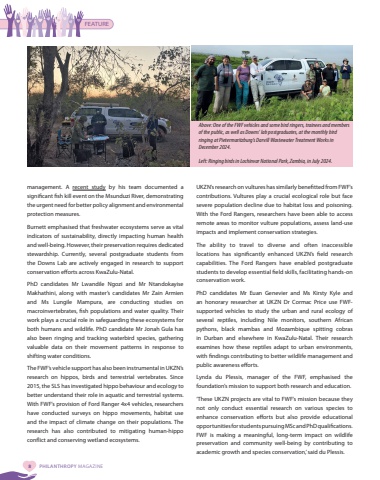
FEATURE8 PHILANTHROPY MAGAZINELeft: Ringing birds in Lochinvar National Park, Zambia, in July 2024. Above: One of the FWF vehicles and some bird ringers, trainees and members of the public, as well as Downs%u2019 lab postgraduates, at the monthly bird ringing at Pietermaritzburg%u2019s Darvill Wastewater Treatment Works in December 2024.management. A recent study by his team documented a significant fish kill event on the Msunduzi River, demonstrating the urgent need for better policy alignment and environmental protection measures.Burnett emphasised that freshwater ecosystems serve as vital indicators of sustainability, directly impacting human health and well-being. However, their preservation requires dedicated stewardship. Currently, several postgraduate students from the Downs Lab are actively engaged in research to support conservation efforts across KwaZulu-Natal. PhD candidates Mr Lwandile Ngozi and Mr Ntandokayise Makhathini, along with master%u2019s candidates Mr Zain Armien and Ms Lungile Mampura, are conducting studies on macroinvertebrates, fish populations and water quality. Their work plays a crucial role in safeguarding these ecosystems for both humans and wildlife. PhD candidate Mr Jonah Gula has also been ringing and tracking waterbird species, gathering valuable data on their movement patterns in response to shifting water conditions.The FWF%u2019s vehicle support has also been instrumental in UKZN%u2019s research on hippos, birds and terrestrial vertebrates. Since 2015, the SLS has investigated hippo behaviour and ecology to better understand their role in aquatic and terrestrial systems. With FWF%u2019s provision of Ford Ranger 4x4 vehicles, researchers have conducted surveys on hippo movements, habitat use and the impact of climate change on their populations. The research has also contributed to mitigating human-hippo conflict and conserving wetland ecosystems.UKZN%u2019s research on vultures has similarly benefitted from FWF%u2019s contributions. Vultures play a crucial ecological role but face severe population decline due to habitat loss and poisoning. With the Ford Rangers, researchers have been able to access remote areas to monitor vulture populations, assess land-use impacts and implement conservation strategies.The ability to travel to diverse and often inaccessible locations has significantly enhanced UKZN%u2019s field research capabilities. The Ford Rangers have enabled postgraduate students to develop essential field skills, facilitating hands-on conservation work.PhD candidates Mr Euan Genevier and Ms Kirsty Kyle and an honorary researcher at UKZN Dr Cormac Price use FWFsupported vehicles to study the urban and rural ecology of several reptiles, including Nile monitors, southern African pythons, black mambas and Mozambique spitting cobras in Durban and elsewhere in KwaZulu-Natal. Their research examines how these reptiles adapt to urban environments, with findings contributing to better wildlife management and public awareness efforts.Lynda du Plessis, manager of the FWF, emphasised the foundation%u2019s mission to support both research and education. %u2018These UKZN projects are vital to FWF%u2019s mission because they not only conduct essential research on various species to enhance conservation efforts but also provide educational opportunities for students pursuing MSc and PhD qualifications. FWF is making a meaningful, long-term impact on wildlife preservation and community well-being by contributing to academic growth and species conservation,%u2019 said du Plessis.


