


Page 10 - Demo
P. 10
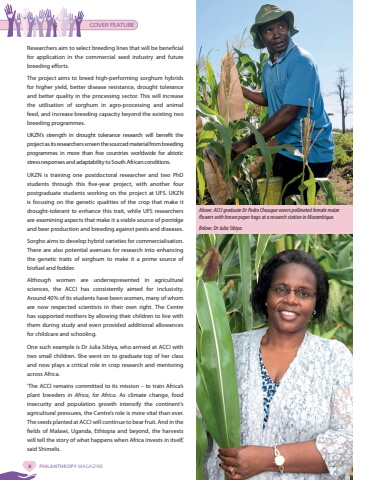
8 PHILANTHROPY MAGAZINECOVER FEATUREResearchers aim to select breeding lines that will be beneficial for application in the commercial seed industry and future breeding efforts.The project aims to breed high-performing sorghum hybrids for higher yield, better disease resistance, drought tolerance and better quality in the processing sector. This will increase the utilisation of sorghum in agro-processing and animal feed, and increase breeding capacity beyond the existing two breeding programmes.UKZN%u2019s strength in drought tolerance research will benefit the project as its researchers screen the sourced material from breeding programmes in more than five countries worldwide for abiotic stress responses and adaptability to South African conditions.UKZN is training one postdoctoral researcher and two PhD students through this five-year project, with another four postgraduate students working on the project at UFS. UKZN is focusing on the genetic qualities of the crop that make it drought-tolerant to enhance this trait, while UFS researchers are examining aspects that make it a viable source of porridge and beer production and breeding against pests and diseases. Sorgho aims to develop hybrid varieties for commercialisation. There are also potential avenues for research into enhancing the genetic traits of sorghum to make it a prime source of biofuel and fodder.Although women are underrepresented in agricultural sciences, the ACCI has consistently aimed for inclusivity. Around 40% of its students have been women, many of whom are now respected scientists in their own right. The Centre has supported mothers by allowing their children to live with them during study and even provided additional allowances for childcare and schooling.One such example is Dr Julia Sibiya, who arrived at ACCI with two small children. She went on to graduate top of her class and now plays a critical role in crop research and mentoring across Africa.%u2018The ACCI remains committed to its mission %u2013 to train Africa%u2019s plant breeders in Africa, for Africa. As climate change, food insecurity and population growth intensify the continent%u2019s agricultural pressures, the Centre%u2019s role is more vital than ever. The seeds planted at ACCI will continue to bear fruit. And in the fields of Malawi, Uganda, Ethiopia and beyond, the harvests will tell the story of what happens when Africa invests in itself,%u2019 said Shimelis. Above: ACCI graduate Dr Pedro Chauque covers pollinated female maize flowers with brown paper bags at a research station in Mozambique.Belo Dr Julia Sibiya.Dr Julia Sibiya.


