


Page 8 - Demo
P. 8
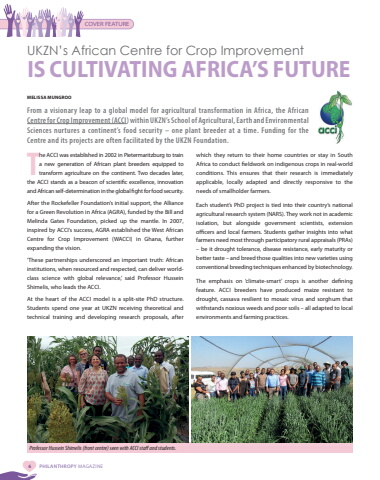
6 PHILANTHROPY MAGAZINECOVER FEATUREUKZN%u2019s African Centre for Crop Improvement IS CULTIVATING AFRICA%u2019S FUTUREMELISSA MUNGROOFrom a visionary leap to a global model for agricultural transformation in Africa, the African Centre for Crop Improvement (ACCI) within UKZN%u2019s School of Agricultural, Earth and Environmental Sciences nurtures a continent%u2019s food security %u2013 one plant breeder at a time. Funding for the Centre and its projects are often facilitated by the UKZN Foundation. The ACCI was established in 2002 in Pietermaritzburg to train a new generation of African plant breeders equipped to transform agriculture on the continent. Two decades later, the ACCI stands as a beacon of scientific excellence, innovation and African self-determination in the global fight for food security.After the Rockefeller Foundation%u2019s initial support, the Alliance for a Green Revolution in Africa (AGRA), funded by the Bill and Melinda Gates Foundation, picked up the mantle. In 2007, inspired by ACCI%u2019s success, AGRA established the West African Centre for Crop Improvement (WACCI) in Ghana, further expanding the vision.%u2018These partnerships underscored an important truth: African institutions, when resourced and respected, can deliver worldclass science with global relevance,%u2019 said Professor Hussein Shimelis, who leads the ACCI. At the heart of the ACCI model is a split-site PhD structure. Students spend one year at UKZN receiving theoretical and technical training and developing research proposals, after which they return to their home countries or stay in South Africa to conduct fieldwork on indigenous crops in real-world conditions. This ensures that their research is immediately applicable, locally adapted and directly responsive to the needs of smallholder farmers.Each student%u2019s PhD project is tied into their country%u2019s national agricultural research system (NARS). They work not in academic isolation, but alongside government scientists, extension officers and local farmers. Students gather insights into what farmers need most through participatory rural appraisals (PRAs) %u2013 be it drought tolerance, disease resistance, early maturity or better taste %u2013 and breed those qualities into new varieties using conventional breeding techniques enhanced by biotechnology.The emphasis on %u2018climate-smart%u2019 crops is another defining feature. ACCI breeders have produced maize resistant to drought, cassava resilient to mosaic virus and sorghum that withstands noxious weeds and poor soils %u2013 all adapted to local environments and farming practices.Professor Hussein Shimelis (front centre) seen with ACCI staff and students.


