
University of KwaZulu-Natal (UKZN) researchers are playing a vital role in an innovative aviation safety and conservation initiative that is helping protect bird species, including millions of migratory Barn Swallows, while enhancing flight safety at King Shaka International Airport (KSIA).
The project, a collaboration between HENSOLDT South Africa, Robin Radar Systems, Airports Company South Africa (ACSA) and UKZN, has resulted in the deployment of a state-of-the-art bird detection radar system at KSIA, making it one of only two airports on the African continent to operate this advanced technology.
“HENSOLDT has extensive experience integrating radar technologies at airports across Africa,” says Christiaan Pelser, Head of ATM and Services at HENSOLDT South Africa. “This project builds on that expertise, combining operational safety with environmental responsibility in a way that reflects the evolving priorities of the aviation sector.”
At the centre of the initiative is the conservation of the Barn Swallow (Hirundo rustica), known in isiZulu as the inkonjane yaseYurobhu (swallow from Europe), a remarkable migratory species that travels thousands of kilometres annually between Europe and other parts of the world, including southern Africa.
KwaZulu-Natal is home to the internationally renowned Mount Moreland Barn Swallow roost, where an estimated three million swallows gather each evening between September and March. Located only a few kilometres from King Shaka International Airport, the roost represents one of the largest concentrations of these migratory birds in the world.
While the spectacle attracts bird enthusiasts and researchers from across the globe, it also presents unique challenges for aviation safety as the birds’ flight paths intersect with aircraft operations around the airport.
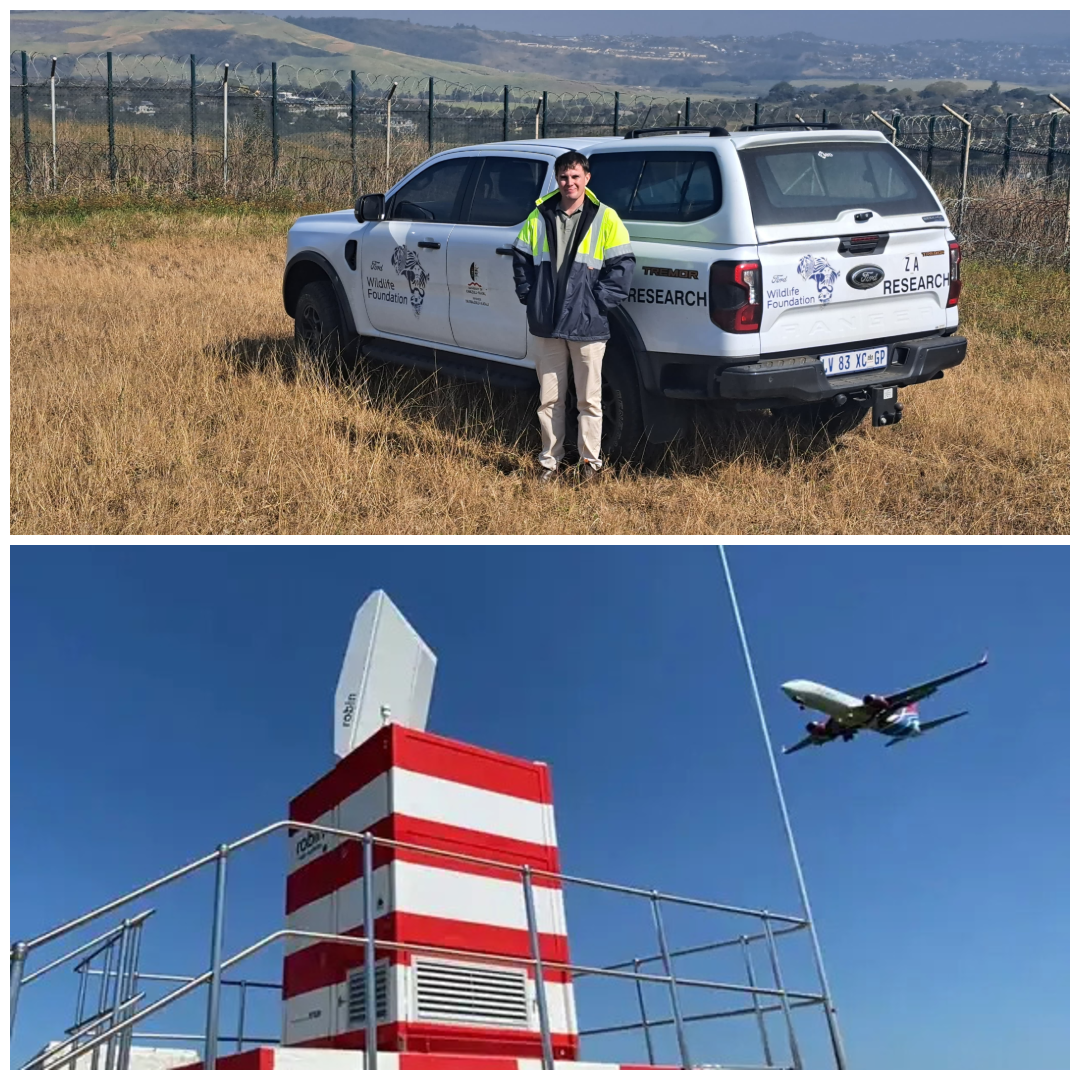
To address this challenge, KSIA has upgraded to Robin Radar Systems’ MAX bird detection radar, a cutting-edge full 3D avian radar system capable of monitoring bird movements in real time. The radar can track more than 3 000 birds simultaneously within a 15-kilometre radius, providing detailed information on flight paths, altitude, speed and flock behaviour.
Mr Nkosinathi Myataza, ACSA Regional General Manager, states, “The system represents a significant upgrade and forms part of our regular assessment of our infrastructure and systems to ensure that it remains fit for purpose. This technology provides our wildlife management teams unprecedented visibility of bird activity around the airport, enabling proactive decision-making that strengthens aviation safety while protecting local biodiversity.”
For UKZN researchers, however, the technology offers far more than an aviation safety solution.
The University’s Discipline of Biological Sciences has become an integral part of the programme through a dedicated research partnership aimed at advancing scientific understanding of bird species movements around the airport, migration arrival and departure patterns and habitat use in the vicinity.
The research team is led by Professor Colleen Downs, National Research Foundation (NRF) South African Research Chairs Initiative (SARChI) Chair in Ecosystem and Biodiversity in KwaZulu-Natal and the Eastern Cape.
Working alongside Professor Downs are Dr Cameron Cormac, a Postdoctoral Fellow, and MSc candidate Matthew Wilkinson, who are actively contributing to the project by gathering field data, identifying bird species, and correlating field observations with radar detections.
The team is also responsible for populating the radar system’s species database, enabling researchers and airport officials to better understand which bird species are being detected and how they move through the airport’s surrounding environment.
By integrating field-based ecological observations with sophisticated radar technology, UKZN researchers are helping refine the system for local conditions while generating valuable scientific data that can inform conservation planning and environmental management for years to come.
Traditional bird monitoring methods have relied heavily on human observations and on occasional GPS tracking studies. While these approaches provide valuable insights, they are often limited by daylight hours, weather conditions and the relatively small number of birds that can be monitored at any one time.
“The new radar technology offers a transformative opportunity for ecological research by continuously monitoring birds active in the vicinity of the airport simultaneously, day and night, throughout the year,” said Downs.
This capability is particularly important for understanding the behaviour of communal roosting species such as the Barn Swallow in the vicinity of the airport, whose movements and population dynamics have historically been difficult to study at large scales.
The data generated by the radar programme will contribute to a better understanding of migration arrival and departure times, flock movements, habitat use and environmental conditions that influence bird behaviour around the airport and surrounding ecosystems.
Beyond supporting scientific research, the information gathered will assist ACSA in developing evidence-based habitat management strategies that protect both birds and aircraft operations.
Robin Project Manager and Civil Aviation Team Lead, Mr Alex Coccia, adds: “Though the MAX radar serves as an effective tool to bolster safety and empower bird control teams, its goals in this project are also very much centred around conservation. We’re excited to support King Shaka International, which is championing ecological practices as well as safety, and to work alongside our partners, HENSOLDT. We’ll provide training, support, and expertise, alongside our radar system.”
According to project partners, the initiative represents a model for how technological innovation, conservation science and operational safety can work together to address complex environmental challenges.
Coccia added, “Avian studies like this traditionally relied heavily on human observations, limited by daylight and time. GPS trackers are valuable in uncovering specific bird behaviours, but it is not feasible to tag more than a few dozen birds. Radar can track large flocks, revealing their size, flight paths, altitudes, speeds, and more. Its affinity for mass movements makes it an ideal tool for the study of the Barn Swallow and other bird species in the vicinity of the airport in Durban.”
For UKZN, the collaboration demonstrates the University’s commitment to producing impactful research that extends beyond academia and contributes directly to solving real-world problems.
The project also highlights the growing importance of interdisciplinary partnerships in advancing biodiversity conservation while supporting sustainable economic development and infrastructure growth.
‘As King Shaka International Airport continues to strengthen its environmental management programme, UKZN researchers will remain at the forefront of efforts to ensure that one of KwaZulu-Natal’s most spectacular natural phenomena—the annual migration and austral summer visit of millions of Barn Swallows—can coexist safely alongside one of the province’s most important transport hubs,’ said Downs.
Name of author: Melissa Mungroo mungroo@ukzn.ac.za
Photographer: Supplied