
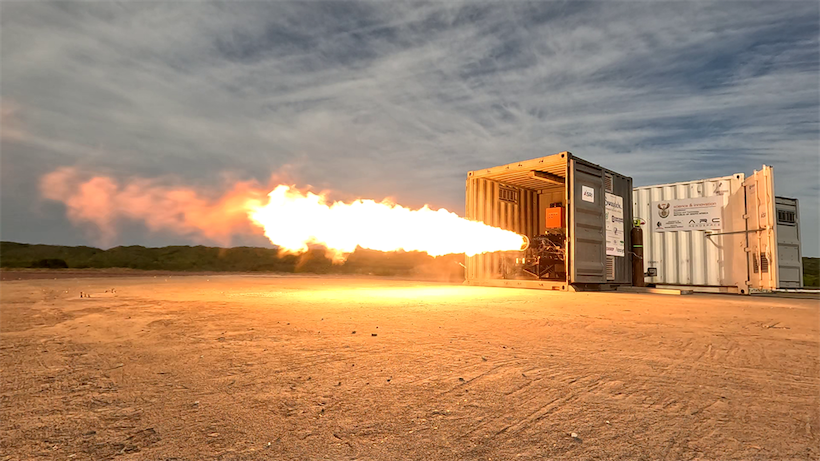
The University of KwaZulu-Natal’s (UKZN) advancements in the field of aerospace engineering are blasting off with an exciting new project focused on the development of 3D-printed rocket engine components.
Mr Nino Wunderlin, Senior Engineer at UKZN’s Aerospace Systems Research Institute (ASRI), has secured a R2.4 million research grant from the Council for Scientific and Industrial Research (CSIR). This grant will support his study on the feasibility and performance of metal additively manufactured (3D-printed) rocket propulsion components, particularly a combustion chamber for the South African Future Integrated Rocket Engine (SAFFIRE) programme.
“The institute is investing heavily in its advanced manufacturing capability,” said ASRI Director Professor Mike Brooks. “Additive manufacturing offers great potential for making aerospace components that are lighter, stronger and quicker to produce, but it’s a complex technology that is not yet fully mature. We’re still exploring what is possible, and this collaborative venture between UKZN and Metal Heart will help push the boundaries of our understanding.”
One of the biggest challenges in rocket propulsion systems is the complexity and cost of manufacturing combustion chambers. These critical components are typically produced through intricate machining and assembly processes that are expensive, time-consuming and often result in high scrap rates.
By leveraging cutting-edge metal additive manufacturing techniques, the UKZN research team aims to significantly streamline the production process, reduce costs and enhance the performance of rocket engines.
“The use of 3D printing in aerospace manufacturing opens up new possibilities by enabling the creation of geometries that would be impossible to achieve through traditional methods,” said Wunderlin.
The key objective of the project will be to demonstrate the feasibility of 3D printing in producing rocket engine combustion chambers that feature high-performance cooling channels and improved material efficiency.
“This approach not only reduces the overall cost of production but also enhances the performance of the components, making them more reliable and efficient in extreme conditions,” he explained. “The project will focus on optimising the design and testing processes by using rapid prototyping and iterative design improvements. This is not just about printing a component; it’s about leveraging the flexibility of 3D printing to iterate and improve the design quickly, making it ideal for the fast-paced development environment of aerospace engineering.”
The Collaborative Programme in Additive Manufacturing (CPAM) grant from the CSIR was awarded following a highly competitive selection process, with the proposal demonstrating the technological innovation of 3D printing and its potential impact across multiple industry sectors.
Wunderlin emphasised the strategic importance of the project in advancing South Africa’s capabilities in additive manufacturing, an area where the country has immense growth potential.
“In addition to the technical aspects, this project also includes a component for student support,” added Brooks. “Our postgraduate students here at UKZN are being exposed to ground-breaking research in aerospace propulsion and advanced manufacturing.”
“We are thrilled to partner with Metal Heart on this project,’ said Wunderlin. “Their expertise in 3D printing combined with our research capabilities at ASRI creates the perfect synergy for advancing this project and enhancing local capabilities in aerospace manufacturing.”
The three-year project will focus on refining the design and testing of the 3D-printed combustion chamber. By the end of the first year, the team aims to have the prototype of the combustion chamber ready for testing, with each subsequent prototype being optimised for improved performance.
The iterative nature of this project will ensure continuous improvements, eventually leading to a fully functional combustion chamber ready for integration into the SAFFIRE programme.
“As the research progresses, it will provide invaluable insights into the performance of 3D-printed propulsion components in extreme combustion environments,” said Wunderlin. “These findings could have wide-ranging applications, benefiting the broader aerospace industry and helping to build local expertise in the production of advanced propulsion systems.”
UKZN runs the only university-based rocket propulsion research programme in South Africa and is committed to advancing additive manufacturing for aerospace applications. The collaboration with Metal Heart and the support from CSIR are vital steps toward creating a robust, self-sustaining space engineering industry in South Africa.
“This grant will enable us to make significant progress on 3D printed chambers and is also a testament to the world-class work being done by Nino and the ASRI engineering team,” said Brooks. “ASRI is rethinking the way rocket engines are manufactured and integrating the newest technologies into the design, manufacture and testing of these complex machines. With a new global space race underway, it’s an exciting time to be an engineer.’